KnoWhy #866 | August 19, 2026
Why Does the Old Testament talk about Leviathan?
Post contributed by
Scripture Central
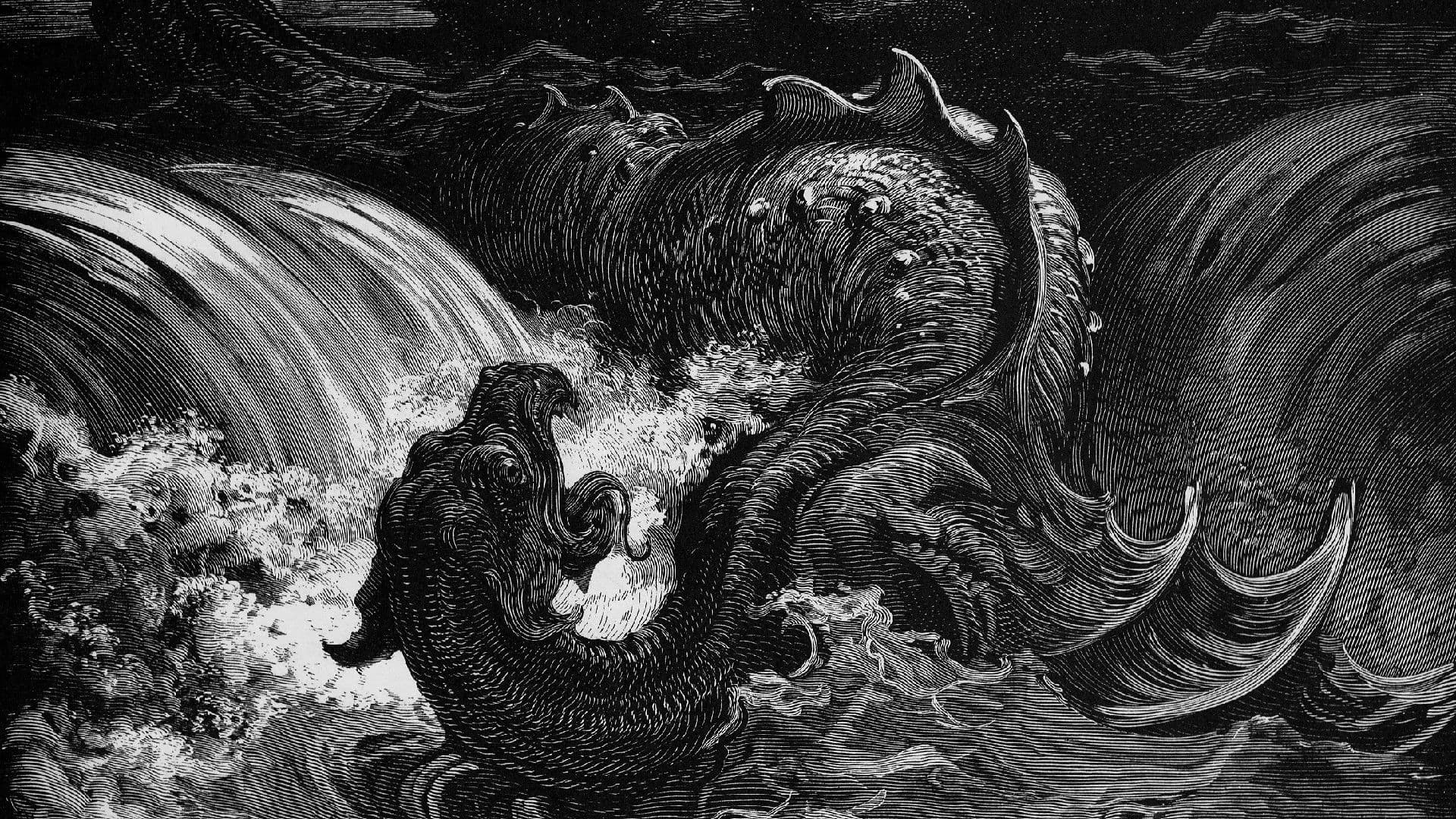
“Thou didst divide the sea by thy strength: thou brakest the heads of the dragons in the waters. Thou brakest the heads of leviathan in pieces, and gavest him to be meat to the people inhabiting the wilderness.” Psalms 74:13–14
The Know
Generally, when one thinks of Creation stories in the Hebrew Bible, one thinks of the opening chapters of Genesis. However, this account is not the only Creation story in the Old Testament. There are narratives of Creation in the Psalms, Job, and Isaiah as well. Understanding creation stories from other cultures of the ancient Near East helps us see and understand these other creation stories in the Bible more clearly.
One creation story from Babylonian culture is the Enuma Elish, named after the first two words of the epic which mean “When on High…”1 In this creation story, the earth is created in an unusual way. According to Enuma Elish, there was once a cosmic sea-monster named Tiamat who was thought to live in the watery chaos that ancient people assumed filled the universe.2 Tiamat swears to destroy the Mesopotamian gods as part of her ongoing conflict with them. Understandably worried, the gods pick one of their number, the patron god of Babylon named Marduk, to go out and fight Tiamat. He takes special divine weapons with him. After catching Tiamat in a cosmic net, he kills her and divides her body in two, using half to create the heavens and half to create the earth. He creates light first to overcome the primordial darkness of the great deep, then the heavens are created as well as the sun, moon, stars, and planets. Humans are then created last from the blood of one of the gods who is sacrificed for that purpose. The story concludes with the creation of a temple to Marduk.3
Some texts in the Old Testament appear to allude to a similar myth from ancient Canaan. Psalms 74:14, 89:10, and 104:26, as well as Isaiah 27:1 and 51:9 refer to beings known as Leviathan and Rahab whom Yahweh slays. Although cryptic, these verses are understood by many biblical scholars to be a reference to a myth in which Yahweh kills a cosmic sea-monster.4 Yahweh was thought to have killed one such sea-monster and created the earth out of the body, as in Enuma Elish.5
One sees subtle references to this in Genesis as well.6 Just as Marduk tears apart the monster to create the heavens and earth, God “separates” the waters above the firmament from the waters below the firmament (Genesis 1:7). Thus, both the Old Testament and Enuma Elish contain the notion of a God who destroys chaos and turns it into order.7
The Why
The Old Testament often depicts God as a divine warrior.8 However, seeing Him as a warrior that destroys chaos elevates the way readers see Him. Rather than fighting human foes, like regular humans do, He fights and destroys even chaos itself and creates order from the wreckage. Seeing God this way reminds modern readers that God can also destroy the chaos and bring order to the lives of people today.
Daniel Belnap, “‘I Will Contend with Them That Contendeth with Thee’: The Divine Warrior in Jacob’s Speech of 2 Nephi 6–10,” Journal of the Book of Mormon and Restoration Scripture 17, no. 1–2 (2008): 20–39.
David E. Bokovoy and John A. Tvedtnes, Testaments: Links between the Book of Mormon and the Hebrew Bible (Tooele, UT: Heritage Press, 2003), 79–87.
Donald W. Parry, Jay A. Parry, and Tina M. Peterson, Understanding Isaiah (Salt Lake City: Deseret Book, 1998), 241, 453–54.
Robert L. Millet, “Redemption through the Holy Messiah (2 Nephi 6–10),” in Studies in Scripture, vol. 7: 1 Nephi to Alma 29, ed. Kent P. Jackson (Salt Lake City: Deseret Book, 1987), 119.
- 1. For an introduction to Enuma Elish, see George, R. (2003), The Babylonian Gilgamesh Epic: Introduction, Critical Edition, and Cuneiform Texts, 2 vols, Oxford: Oxford University Press.
- 2. For an overview, see Frahm, E. (2013), ‘Creation and the Divine Spirit in Babel and Bible: Reflections on mummu in Enuma Elish I 4 and rûah in Genesis 1:2’, in D. S. Vanderhoof and A. Winitzer (eds), Literature as Politics, Politics as Literature: Essays on the Ancient Near East in Honor of Peter Machinist, 97–116, Winona Lake: Eisenbrauns.
- 3. For a summary, see Lambert, G. (2013), Babylonian Creation Myths, Mesopotamian Civilizations 16, Winona Lake: Eisenbrauns.
- 4. See, for example, Othmar Keel, The Symbolism of the Biblical World: Ancient Near Eastern Iconography and the Book of Psalms (London: SPCK, 1972), 47, 56, 73–75.
- 5. For more on these connections, see Hendel, R. (2005), ‘Genesis 1–11 and Its Mesopotamian Problem’, in E. S. Gruen (ed.), Cultural Borrowings and Ethnic Appropriations in Antiquity, 23–36, Stuttgart: Steiner.
- 6. For more on how ancient myths like Enuma Elish were adapted in the Hebrew Bible, see Frymer-Kensky, T. (1992), In the Wake of the Goddesses: Women, Culture, and the Biblical Transformation of Pagan Myth, New York: Free Press.
- 7. For an excellent volume on this, see Carr, M. (2020), The Formation of Genesis 1–11: Biblical and Other Precursors, Oxford: Oxford University Press and also Sparks, L. (2007), ‘Enūma elish and Priestly Mimesis: Elite Emulation in Nascent Judaism’, Journal of Biblical Literature, 126: 625–48.
- 8. See, for example, Exodus 15:3.