KnoWhy #862 | July 21, 2026
Why Does Nehemiah Appeal to the Persian King’s Religion When Asking for Help?
Post contributed by
Scripture Central
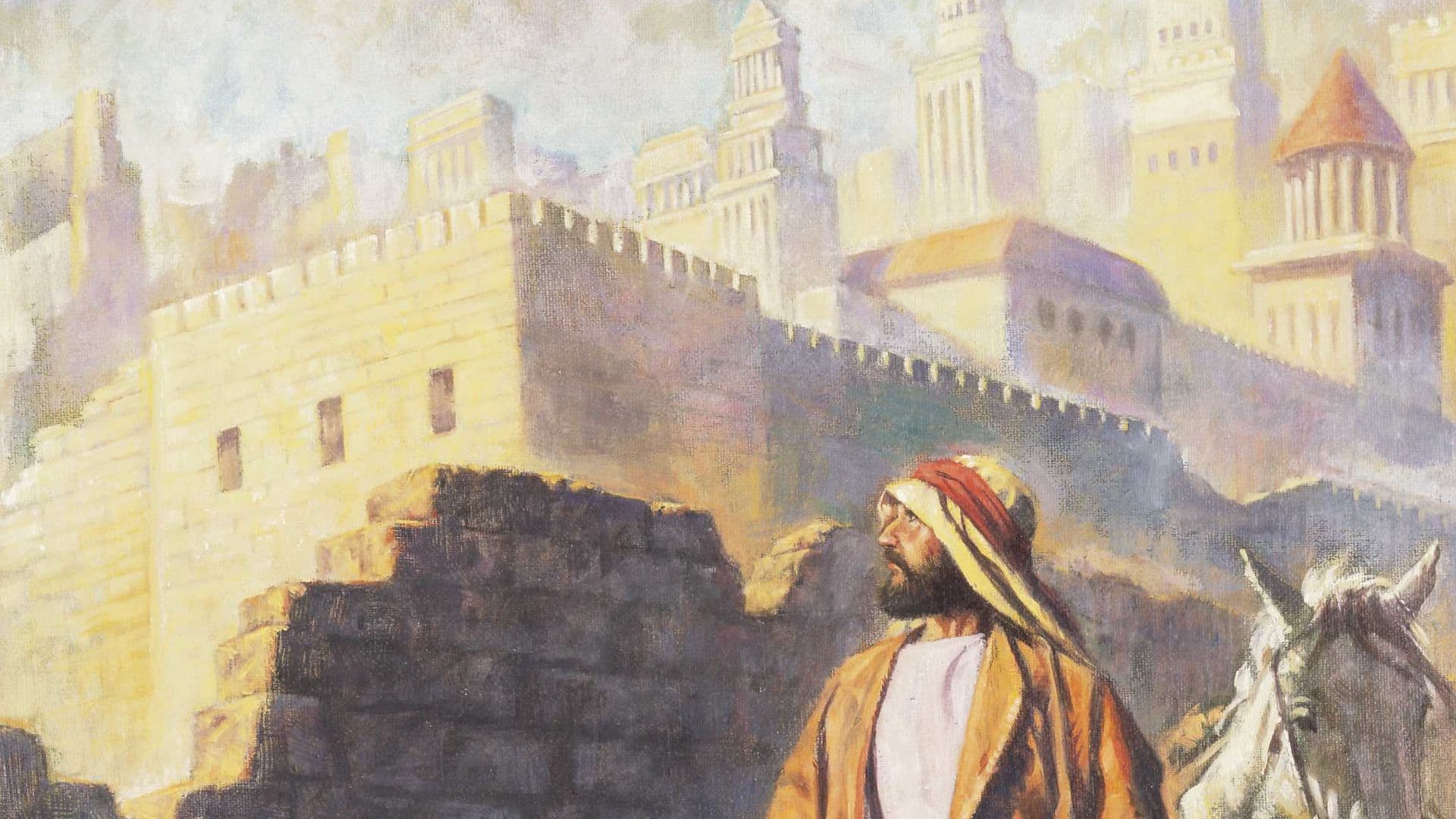
“And said unto the king, Let the king live for ever: why should not my countenance be sad, when the city, the place of my fathers’ sepulchres, lieth waste, and the gates thereof are consumed with fire?” Nehemiah 2:3
The Know
Nehemiah 1 contains something that might seem strange at first. The narrative indicates that “in the month Chisleu” Nehemiah was in Susa, in the heartland of the Persian Empire, when “Hanani, one of my brethren, came, he and certain men of Judah … and they said unto me, The remnant that are left of the captivity there in the province are in great affliction and reproach: the wall of Jerusalem also is broken down, and the gates thereof are burned with fire” (Nehemiah 1:1–3). Nehemiah is pained by this news: “when I heard these words, that I sat down and wept, and mourned certain days, and fasted, and prayed before the God of heaven” (Nehemiah 1:4). However, Nehemiah still waits months to create the conditions to speak about this with the king, not talking about it with him until the month of Nissan (Nehemiah 2:1). One wonders why Nehemiah would have waited so long to create the conditions to bring up a subject that was clearly so important to him. Part of the answer to this question likely lies in the religion of the Achaemenid Persian rulers, a religion which would eventually be known as Zoroastrianism.1 Nehemiah appears to draw on the traditions of this Persian religion when appealing to the king to help him.
The ancient Persian (Iranian) new year celebration, known as Nowruz, takes place during the month of Nissan.2 One common tradition during Nowruz was that the king would give gifts or grant requests to anyone who asked.3 Nehemiah likely waited until Nowruz to ask for help, knowing his request was much more likely to be granted during Nowruz.
Additionally, there are other parts of Nehemiah’s request that appear to relate to the Persian religion. In the exchange between Nehemiah and the king, Artaxerxes, recorded in Nehemiah 2, Nehemiah is clearly upset, and when the king inquires as to the cause of his distress, he asks rhetorically, “Why should not my countenance be sad, when the city, the place of my fathers’ sepulchres, lieth waste, and the gates thereof are consumed with fire?” (Nehemiah 2:3). In Nehemiah’s brief comment, he appeals to Iranian religion by mentioning tombs and fire, two things a Zoroastrian would have seen as especially important.4
Tombs would have been especially important to Zoroastrians for multiple reasons. Zoroastrians believed that the spirits of ancestors lived on in some way, meaning that defiling a tomb would have been seen as unacceptable.5 However, not properly maintaining a tomb could have an even more negative impact. In Zoroastrianism, the earth was seen as holy, as the earth was a representation of the divine being known as Armaiti.6 This is why Zoroastrian tombs were always carved into the rock in such a way that no part of the body would ever come into contact with the soil.7 If a tomb were not maintained well and kept properly sealed, animals could disturb bones, causing them to come into contact with the earth, a serious sin for Zoroastrians.8 Eventually, this problem would be obviated by creating communal towers for the exposure of bodies called dakhmas, known in the West as “towers of silence,” which ensured that bones never came into contact with the earth.9 However, during the time of Nehemiah, Zoroastrians were still using tombs which would need to be carefully maintained.10
Nehemiah’s reference to Jerusalem being burned with fire would also have resonated with Zoroastrians. In Zoroastrianism, fire was also sacred, as it was a representation of the primary Zoroastrian deity known as Ahura Mazda.11 As in the case of the earth, one was also not allowed to corrupt fire by burning bodies.12 The gates of Jerusalem, as in the case of all ancient cities, would have been heavily defended places during an attack, and burning them would almost certainly have involved burning defenders. Hearing that the gates of the city were burned would therefore have troubled a Zoroastrian like Artaxerxes.13 Thus, Nehemiah seems to have said exactly the right thing to persuade the Persian king to help him with his problem by appealing to Artaxerxes’s religious beliefs.
The Why
Nehemiah’s conversation with Artaxerxes is similar to other occasions in the scriptures when people connected with others by appealing to their religious traditions. When teaching polytheists in Athens, Paul draws on their tradition of an “unknown god” (Acts 17:23–28) in a novel way and appeals to their own poets to teach them. In the Book of Mormon, one finds something similar, as Ammon appeals to King Lamoni’s beliefs about the Great Spirit when teaching him the gospel (Alma 18:24–28).
Nehemiah, Ammon, and Paul all remind Latter-day Saints of the importance of understanding the beliefs of others. In a world that can be divided based on people’s views, understanding the beliefs of others is crucial. Nehemiah was able to persuade the Persian king because he was familiar enough with Iranian religion to know the right things to say. However, even if someone is never in a position where they might have to persuade someone based on their beliefs, understanding is still crucial.
As President Russell M. Nelson has declared: “Only the comprehension of the true Fatherhood of God can bring full appreciation of the true brotherhood of man. That understanding inspires desire to build bridges of cooperation instead of walls of segregation. . . . Intolerance seeds contention; tolerance supersedes contention. Tolerance is the key that opens the door to mutual understanding and love.”14
Jared W. Ludlow, “Nehemiah 1–13,” in Old Testament Minute: Nehemiah, ed. Jared M. Halverson, vol. 16. (Book of Mormon Central, 2022).
Dieter F. Uchtdorf, “We Are Doing a Great Work and Cannot Come Down," Ensign, May 2009.
- 1. For an explanation of Zoroastrianism in this period, see Wouter F. M. Henkelman, The Other Gods Who Are: Studies in Elamite-Iranian Acculturation Based on the Persepolis Fortification Texts, Achaemenid History 14 (Nederlands Instituut voor het Nabije Oosten, 2008).
- 2. Joseph Fleishman, “The Rebuilding of the Wall of Jerusalem: Neh 2:1-9 and the Use of Zoroastrian Principles,” Journal of Northwest Semitic Languages 34.2 (2008): 70–73.
- 3. Fleishman, “The Rebuilding of the Wall of Jerusalem,” 70–73.
- 4. Fleishman, “The Rebuilding of the Wall of Jerusalem,” 74–75.
- 5. Fleishman, “The Rebuilding of the Wall of Jerusalem,” 74–75.
- 6. For the worship of Armaiti during the Achaemenid Period, see P.O. Skærvø, “The Achaemenids and the Avesta,” in Birth of the Persian Empire, ed. Vesta Sarkhosh Curtis and Sarah Stewart, The Idea of Iran 1 (Bloomsbury Academic, 2021), 54.
- 7. Mary Boyce, “Achaemenid Religion,” in Encyclopædia Iranica, last modified July 21, 2011 http://www.iranicaonline.org/articles/achaemenid-religion.
- 8. Fleishman, “The Rebuilding of the Wall of Jerusalem,” 74–75.
- 9. Mehrdad Shookoohy, “The Zoroastrian Towers of Silence in the Ex-Portuguese Colony of Diu,” Bulletin of the Asia Institute 21 (2007): 61–78.
- 10. Boyce, “Achaemenid Religion.”
- 11. For the significance of fire in Zoroastrianism, see David Stronach, “The Kūh-i-Shahrak Fire Altar,” Journal of Near Eastern Studies 25.4 (1966): 217–27.
- 12. For more on the sacred nature of fire in Zoroastrianism, see D. Stronach, “On the Evolution of the Early Iranian Fire Temple,” in Papers in Honour of Professor Mary Boyce, Acta Iranica 25 (Peeters, 1985), 605–27.
- 13. Fleishman, “The Rebuilding of the Wall of Jerusalem,“ 74–75.
- 14. Russell M. Nelson, “Teach Us Tolerance and Love,“ April 1994 General Conference.