KnoWhy #847 | April 7, 2026
Why Does Contextualizing the Exodus Story Matter?
Post contributed by
Scripture Central
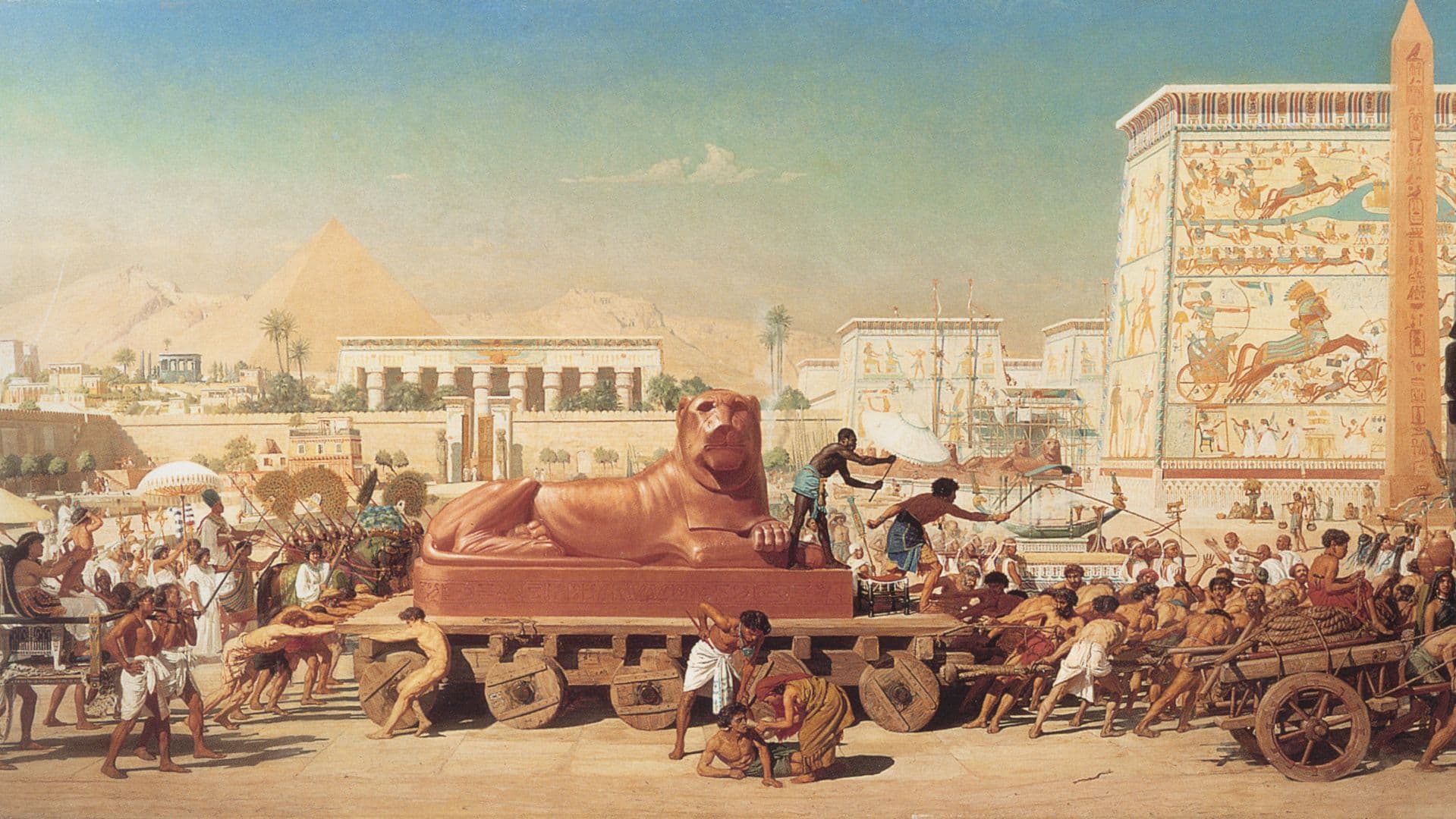
“I will be honoured upon Pharaoh, and upon all his host; that the Egyptians may know that I am the Lord.” Exodus 14:4
The Know
The Book of Exodus repeatedly reports that Moses and the Hebrews interacted with the Pharaoh, trying to convince him to let the Hebrews go, and in Exodus 14:27, the army of Pharaoh drowns in the Red Sea. But the text never states which pharaoh this is, making it difficult to contextualize the biblical account. 1 Kings 6 states that when Solomon began to build the temple in approximately 966 BC, it had been 480 years since the children of Israel left Egypt.1 966 plus 480 years is 1446 BC, so one would assume that it must be the pharaoh at this date.2 However, 480 years is almost certainly supposed to be a symbolic number—the result of multiplying 12, a significant number in ancient Israel, with 40, the number of years which represented a generation in ancient Israel.3 So people interested in knowing who the pharaoh of the Exodus is need to examine additional historical evidence to narrow down the possible candidates. Scholars have identified Ramesses II as a good candidate for the pharaoh of the Exodus.
The latest possible date for the Exodus can be established, because a pharaoh named Merneptah erected a stela with an inscription in which he claimed to have eliminated the Israelites.4 This was clearly exaggeration, as Israel survived for hundreds of years after this stela was erected, but in bragging about their elimination, he provided a useful piece of evidence which helps to date the Exodus. In Egyptian hieroglyphs, the final character(s) of a word was often a determinative—an unspoken glyph that helped classify the word into various semantic categories (e.g., humans and social roles, divinity, places or buildings, actions, abstract concepts, etc.). In the Merneptah stela, the word for Israel was given a determinative indicating that they were not an established people in a city, like some of the other nations on the list, but simply a people, perhaps nomadic.5 This strongly suggests that Merneptah encountered the Israelites at some point before they were firmly established in the land of Canaan, suggesting that the Exodus took place a comparatively short time before the time of Merneptah.6 This would allow for the period of wilderness wandering to elapse but would not allow for enough time for the Israelites to have become fairly well-entrenched in the land.7 This suggests that Merneptah’s father, Ramesses II, is a likely candidate for the pharaoh of the Exodus.8
Exodus 1:11 is also suggestive in this regard. It states that the Israelites worked on building a city called Ramesses. This detail only makes sense during the reign of Ramesses II who built a capital city called Pi-Ramesses.9 However, there is another detail which also suggests that Ramesses II could have been the pharaoh of the Exodus. The result of the catastrophic tenth plague which the Lord brought upon the Egyptians was that the firstborn of the land of Egypt would die unless they placed the blood of a lamb of their doorframes (Exodus 12:12, 23). This corresponds with what is known of the life of Ramesses II, whose firstborn son Amun-her-khepeshef died prematurely.10
The Why
Although it is difficult to be completely sure, this evidence suggests Ramesses II may well have been the pharaoh of the Exodus. This is significant for a few reasons. First, it allows readers to situate the Exodus in a real time and place. If Ramesses II is the pharaoh of the Exodus, then the last plague took place around 1254 BC, killing his firstborn son, Amun-her-khepeshef.11
Second, this perspective also teaches the reader something important about God’s power. Ramesses II was known for leading his army through many successful military campaigns, fighting in Syria, Nubia, and Lybia.12 However, if Ramesses II is indeed the pharaoh of the Exodus, then this is a potent reminder that God is more powerful than even the most powerful of earthly rulers.
This knowledge can give people confidence to deal with the difficulties they face. Nephi referred to the destruction of Pharaoh’s army to remind his brothers that God would help them like He helped Moses, “for he truly spake unto the waters of the Red Sea and they divided hither and thither, and our fathers came through, out of captivity, on dry ground, and the armies of Pharaoh did follow and were drowned in the waters of the Red Sea” (1 Nephi 4:2). If God could do this for the ancient Israelites, he could certainly help them. “Now behold ye know that this is true; and ye also know that an angel hath spoken unto you; wherefore can ye doubt? Let us go up; the Lord is able to deliver us, even as our fathers, and to destroy Laban, even as the Egyptians” (1 Nephi 4:3). This knowledge can help every reader of the Bible today as well. If God could deliver the Hebrews from a successfully military leader like Ramesses II, he can deliver people from whatever difficulties they might face.
Wally Breitenstein, “Exodus 14-17,” in Old Testament Minute: Exodus, edited by Taylor Halverson, Vol. 2 (Book of Mormon Central, 2022).
Jeffrey M. Bradshaw, “Is There Any Evidence in Egyptian Sources for the Exodus?,” KnoWhy OTL13C (January 22, 2018).
- 1. Carol A. Redmount, “Bitter Lives: Israel In and Out of Egypt,” in The Oxford History of the Biblical World, ed. Michael D. Coogan (Oxford University Press, 1998), 78-79.
- 2. Redmount, “Bitter Lives,” 78-79.
- 3. Redmount, “Bitter Lives,” 78-79.
- 4. Redmount, “Bitter Lives,” 71-72.
- 5. Redmount, “Bitter Lives,” 71-72.
- 6. Redmount, “Bitter Lives,” 71-72.
- 7. Redmount, “Bitter Lives,” 71-72.
- 8. Redmount, “Bitter Lives,” 71-72.
- 9. Barbara J. Sivertsen, “Dating the Exodus,” in The Parting of the Sea: How Volcanoes, Earthquakes, and Plagues Shaped the Story of Exodus, 1–9 (Princeton University Press, 2009), 1.
- 10. Aidan Dodson & Dyan Hilton, The Complete Royal Families of Ancient Egypt, (Thames & Hudson, 2004), 173.
- 11. For this date, see Dodson and Hilton, Complete Royal Families, 173.
- 12. For more on the Egyptian army at this time, see R. Gabriel, The Great Armies of Antiquity, (Greenwood Publishing Group, 2002), 6.