KnoWhy #851 | May 5, 2026
Why are Early Israelite Settlements Similar to Those Where They Wandered for Forty Years?
Post contributed by
Scripture Central
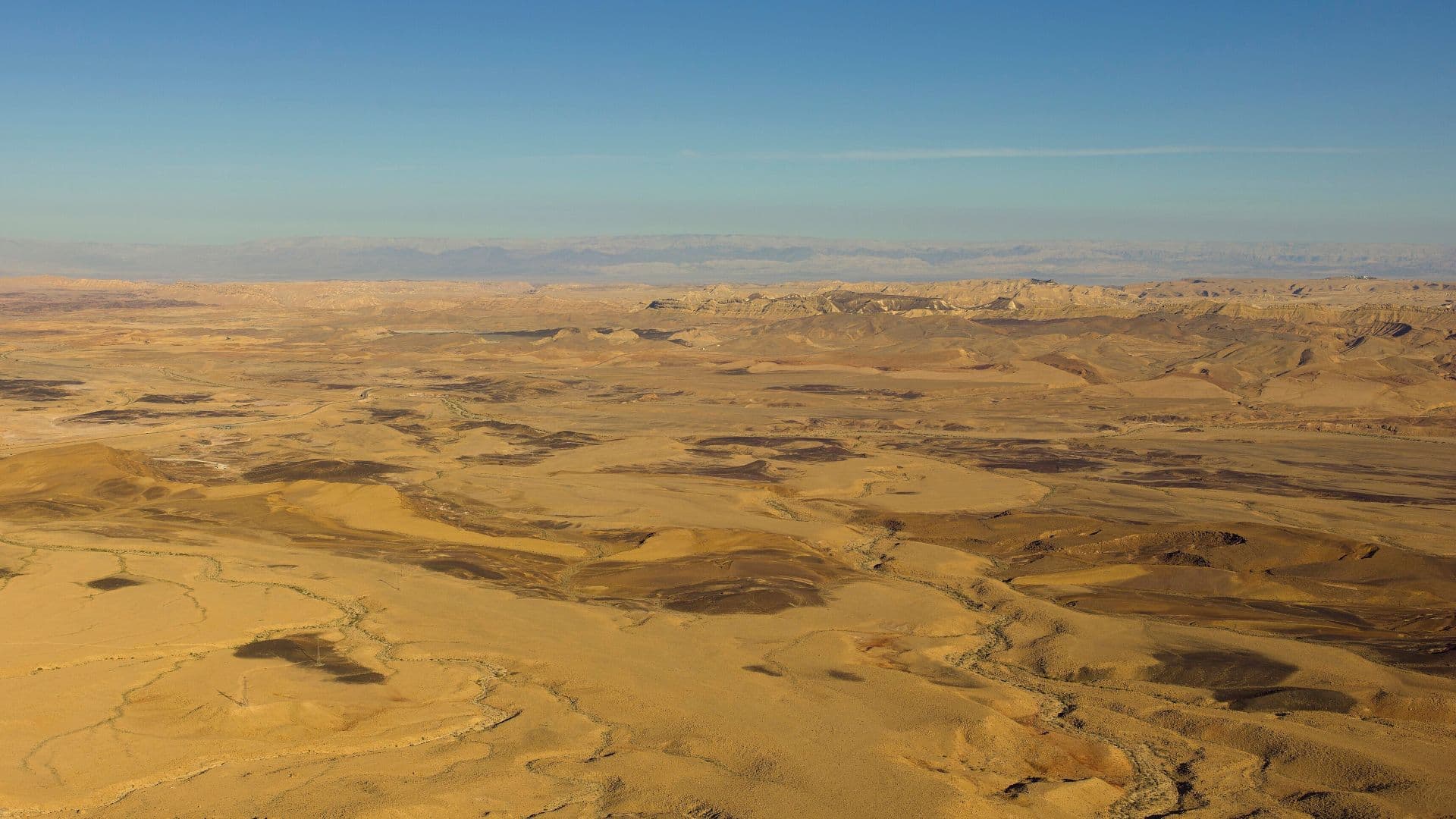
“And thou shalt remember all the way which the Lord thy God led thee these forty years in the wilderness, to humble thee, and to prove thee, to know what was in thine heart, whether thou wouldest keep his commandments, or no.” Deuteronomy 8:2
The Know
The Book of Deuteronomy records that the Hebrews spent forty years in the Sinai wilderness before entering the promised land. The people who will enter the promised land with Joshua would have spent most of their lives in the Sinai and Negev (S. Israel) deserts as well as in the territory of present-day Jordan.1 Having spent so much time in these locations and interacting with local populations, one might wonder how this impacted the Hebrews’ day-to-day lives. A close examination of archaeological evidence from the earliest Israelite sites gives us some insight.
One of the earliest identifiable Israelite settlements is a place called Izbet Sartah, in the western portion of the highland area settled by the Israelites.2 As archaeologists dug through the different layers of the site to get to the remains of the first Israelite settlement, they noticed something strange. Later Israelite settlement layers consist of clusters of a distinctive type of building known as Pillared Houses.3 In the earliest settlement layer, by contrast, the buildings were in an entirely different configuration. The entire settlement consisted of a large oval ring of rooms surrounding a huge inner courtyard.4 The doors of the rooms all faced towards the courtyard, meaning that the buildings formed a wall protecting both the people in the compound and the inner court.5
This setup provides a connection between the wanderings in the desert and ancient Israel, because similar oval settlements are found in a small number of other places in the ancient Near East and most are within the area the Hebrews would have traveled through in the wilderness.6 One finds sites like this from the Bronze and Iron Ages, and they are all remarkably similar in size, shape, and even number of rooms.7 As recently as the early 20th century, people have described and photographed nomadic peoples in these deserts arranging their tents in this way.8 Just like the settlements, the tents are arranged in an oval with the doors all facing inward, to take care of the animals in the “courtyard” created by arranging the tents this way.9 Even the location of the earliest Israelite settlements is significant in this regard. Many of the earliest Israelite settlements are found near the desert fringe, where it would be easiest to continue to do the kind of herding they were accustomed to, and not farther west, which was less conducive to raising sheep and goats.10
Although one cannot be sure, it is possible that the ancient Israelites saw settlements like this in the Negev, Sinai, and other areas, and adopted this type of settlement pattern when they moved into the promised land.11 This would explain why one finds similar settlement designs both in the desert fringe where the Hebrews spent their period of wilderness wandering, as well as in the highlands of Israel itself. If this is true, then this style of settlement establishes a strong connection between the Sinai, Negev, and southern Transjordan areas, where the Hebrews were thought to have spent much of their time during their wilderness wandering, and the highlands of Canaan, where they eventually settled.
The Why
There is something poignant about the image of the ancient Hebrews painted by the archaeological evidence explored above. They had wandered for so many years that their period of wandering became a part of them, and they brought elements of it with them into the promised land. It is easy to forget, when reading Deuteronomy, that the people Moses is depicted talking to in the book have lived in the wilderness most of their lives. The wilderness is what they knew, and when they came into the promised land, they brought a little piece of the wilderness with them in their living arrangements.
In ancient times as well as today, difficult experiences can shape who people become, and they sometimes bring elements of those times with them into their later lives. From people who grew up in poverty whose relationship with wealth is forever changed, to exhausted young mothers who never sleep in quite the same way they did before having children, to military veterans who are startled by loud noises years after returning from the front, difficult experiences can contribute to who people eventually become.
However, through the Atonement of Jesus Christ, these experiences can become redemptive rather than limiting. The Hebrews were able to create a new home for themselves in the promised land, despite their limitations, and people today can also receive God’s help to become what He wants them to become, regardless of what happened to them in the past.
Philip A. Allred and Neal Rappleye, Old Testament Minute: Deuteronomy, ed. Taylor Halverson, Old Testament Minute, vol. 5 (Book of Mormon Central, 2022).
David R. Seely, "“A Prophet Like Moses” (Deuteronomy 18:15–18) in the Book of Mormon, the Bible, and the Dead Sea Scrolls," Interpreter: A Journal of Latter-day Saint Faith and Scholarship 41, no. 19 (2020).
- 1. Numbers 32:13, see also Numbers 33:3-49.
- 2. Israel Finkelstein and Neil Asher Silberman, The Bible Unearthed: Archaeology’s New Vision of Ancient Israel and the Origin of Its Sacred Texts (Free Press, 2001), 110.
- 3. Finkelstein and Silberman, The Bible Unearthed, 111.
- 4. Finkelstein and Silberman, The Bible Unearthed, 111.
- 5. Finkelstein and Silberman, The Bible Unearthed, 111.
- 6. Finkelstein and Silberman, The Bible Unearthed, 112.
- 7. Finkelstein and Silberman, The Bible Unearthed, 112.
- 8. Finkelstein and Silberman, The Bible Unearthed, 112.
- 9. Finkelstein and Silberman, The Bible Unearthed, 112.
- 10. Finkelstein and Silberman, The Bible Unearthed, 113.
- 11. This is certainly not the conclusion of the author of the book from whom this archaeological evidence was drawn, but is a likely conclusion nevertheless.