KnoWhy #836 | January 27, 2026
What Were the Curse and Mark of Cain?
Post contributed by
Scripture Central
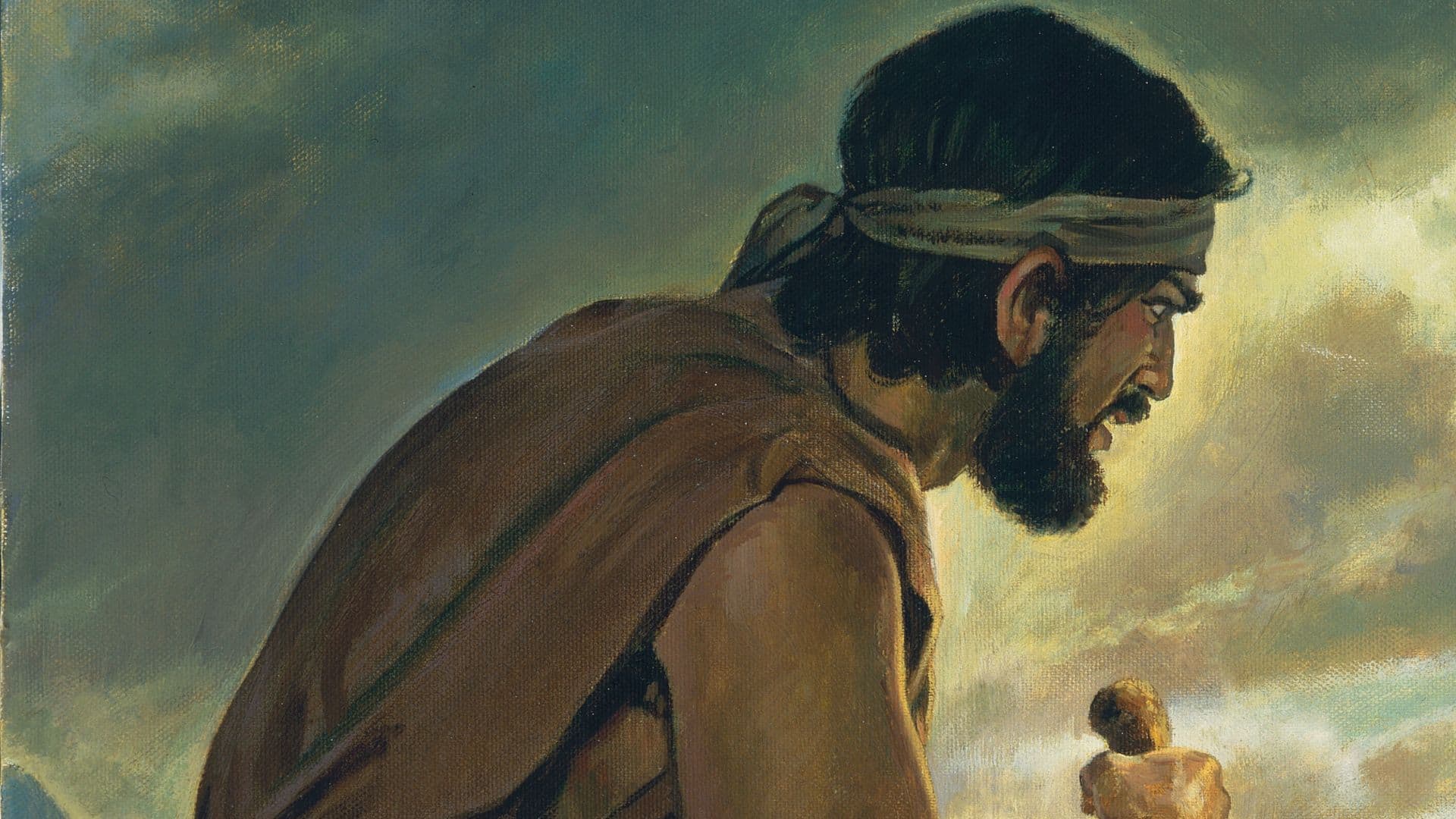
“And Enoch also beheld the residue of the people which were the sons of Adam; and they were a mixture of all the seed of Adam save it was the seed of Cain, for the seed of Cain were black, and had not place among them.” Moses 7:22
The Know
Moses 7 contains an account of a vision experienced by the ancient prophet Enoch. As part of that vision, Enoch saw that the descendants of Adam had mixed with each other except for the descendants of Cain, “for the seed of Cain were black, and had not place among them” (Moses 7:22). One might easily assume the word “black” in this verse is saying something about a dark skin color. However, the ancient texts about Cain suggest this word might mean something completely different.
As is well known, Genesis 4 and Moses 5 contain the story of Cain and Abel in which Cain killed his brother Abel and was cursed by God (Genesis 4:8-12). In fact, nothing is said there about God cursing Cain’s skin. Instead, God curses Cain “from the earth” (v. 11). This was probably understood to mean that Cain would no longer be considered an heir of the earth given by God to his parents, Adam and Eve, as their dominion (Gen. 1:26). In other words, Cain was cursed by being exiled and disinherited from the family’s lands of inheritance. Understandably, Cain is then declared to be a “a fugitive and a wanderer” as one who would no longer benefit from the resources of his family’s kingdom (Gen. 4:12).1 Because many early Jews and Christians believed the earth itself would one day become a heaven, the cursing or banishing of Cain “from the earth” can have very different meanings than people usually assume.2
In addition, consider the following in the Genesis account. In response to his being cursed or banished, Cain cries out to God that anyone who saw him would kill him; but God tells him that if someone were to kill him, a seven-fold vengeance would fall upon that person (v. 14-15). God then set a mark on Cain in order to protect him, so that no one who found him would kill him (v. 15). In later biblical times, one of the relatives of a murdered person (generally a specific person known as an “avenger of blood”) was legally obligated to kill the murderer to avenge the death of his relative.3 Assuming that this idea extended back into earlier times, someone related to Abel would be, in some sense, legally obligated to avenge the death of Abel by killing Cain.4 And so, presumably the mark—whatever it was—somehow warned people of the seven-fold vengeance which God had said would fall upon any other unauthorized person who happened to kill Cain. So the mark somehow exempted Cain from the usual legal duty that normally would fall upon the avenger of blood.5
But in all this, one significant question that the text never answers is this: what was the exact nature of this mark? This glaring absence in the biblical text has prompted a number of people throughout history to attempt to provide some answer to this question.6
For example, one ancient Jewish text, Genesis Rabbah, offers a number of possibilities for what the mark of Cain was. While the ancient Hebrew word ote was translated here as mark, that Hebrew word can also mean sign, and thus some commentators have seen it as something external to Cain. Indeed, two Rabbis state there that it meant that the sun would always shine on him. A third Rabbi thought it could refer to leprosy, and yet another thought it could be a horn that sprouted out of his forehead. A fifth Rabbi even thought that it meant that Cain had been given a dog as a companion, and thus that dog was the sign.7
Targum Pseudo-Jonathan, another ancient commentary on the biblical text, states that “the Lord sealed a letter from the great and illustrious name on Cain’s face.”8 This is a reference to the letters of the name Yahweh, known as the tetragrammaton, suggesting that one letter from this name was permanently marked on Cain’s face. A later tradition contained in a text known as Pirqé Rabbi Eliezer states that the Lord caused a letter to appear on his arm and that this was the sign.9 And Philo, an ancient Jewish author who lived in Egypt and wrote in Greek, thought the mark of Cain was that Cain never died, something he concluded because Cain’s death is never mentioned in scripture.10
Ancient Christian authors also speculated about the meaning of the mark of Cain. One ancient Syriac text called the Life of Abel describes a scene in which Cain comes home after killing Abel and Eve sees a sign on Cain’s forehead and wails in grief.11 In other ancient Christians texts some of Cain’s curses mentioned in Genesis are related to the meaning of the mark. In the ancient Greek translation of Genesis 4:13, instead of saying that Cain would being a “fugitive and a wanderer on the earth,” Cain is described as “groaning and shaking on the earth.” This important Greek rendition of Genesis influenced several early Christian texts such as the Ethiopian Conflict of Adam and Eve from late antiquity. In this text, “Cain trembled and became terrified; and through this sign did God make him an example before all the creation, as the murderer of his brother.”12 Another ancient Armenian Christian text called the Adambook depicts Cain as becoming like a wild animal with a hairy pelt and horns, such that he was mistaken as a wild animal and shot by his descendant, Lamech.13
The Why
In wondering what was meant by the mark of Cain in Genesis, one important point to be made at the outset is that any reference to what modern people refer to as “race” is conspicuously absent in ancient sources. The idea that the mark of Cain had something to do with dark skin can be traced no earlier than to the Middle Ages when Europeans began to associate people of African descent with Cain. A German text from that time, for example, states that people of African descent are the descendants of Cain.14 One portion of the earlier Genesis Rabbah can be interpreted to mean that Cain had dark skin, but that portion of the text has nothing to do with the curse of Cain.15 The same can be said of the ancient Armenian Adambook noted above.16
With this understanding, one returns to Moses 7:8 with fresh eyes. The word “black” in this context almost certainly means something other than skin-color. Indeed, in the 1828 Webster’s Dictionary of the American Language, which reflects the language usages of Joseph Smith’s time, “black” also meant “atrociously wicked,” and that definition fits the context of Moses 7 much better than a reference to skin color does, as the surrounding text refers clearly to people’s wickedness or righteousness, and not to the pigmentation of their skin.17 The term “blackness” also appears in the original manuscript of Moses 1:15, where the text refers to the evil of Satan (who lacks any of God’s light and glory and is therefore “black” in that sense) rather than referring to his skin color.18 Thus, it is reasonable to conclude that “black” means something other than skin color in Moses 7 as well.
This examination of the ancient evidence surrounding both the curse and the mark of Cain may help readers of the Bible to be more cautious when attributing certain meanings to the scriptures. Assuming a racial connotation of the curse and of the mark of Cain is still common in some circles, but a carefully informed reading of the text in Genesis shows that a racial reading was apparently unknown in ancient times and thus is not warranted today. In addition, the “sign” given to Cain may not even have been a mark on Cain’s body like a letter or a horn, but may even have been something like a tendency to tremble or even something having nothing to do with Cain’s body, such as in the case of the text that saw it as a reference to a dog. In the end, one can conclude that it is unclear what the mark of Cain actually amounted to. In any case, it is certainly best not to read later cultural traditions into the surviving biblical text.
Shannon, Avram R. “The Mark and Curse of Cain.” In Old Testament Cultural Insights, edited by Taylor Halverson. Springville, UT: Book of Mormon Central, 2022.
Adam Stokes, "The People of Canaan: A New Reading of Moses 7." Interpreter: A Journal of Latter-day Saint Faith and Scholarship 47 (2021): 159-180.
John S. Thompson, "“Being of that Lineage”: Generational Curses and Inheritance in the Book of Abraham." Interpreter: A Journal of Latter-day Saint Faith and Scholarship 54 (2022): 97-146.
- 1. On the relationship of cursing to disinheritance in the ancient world generally, see John S. Thompson, "’Being of that Lineage’: Generational Curses and Inheritance in the Book of Abraham," Interpreter: A Journal of Latter-day Saint Faith and Scholarship 54 (2022): 97-146.
- 2. See Bart Ehrman, Heaven and Hell: A History of the Afterlife (Simon and Schuster, 2020); J. Richard Middleton, A New Heaven and a New Earth: Reclaiming Biblical Eschatology (Baker, 2014); N. T. Wright, Surprised by Hope: Rethinking Heaven, the Resurrection, and the Mission of the Church (Harper One, 2008); and J. Edward Wright, The Early History of Heaven (Oxford University Press, 2002).
- 3. See, for example, Deuteronomy 19:6, 12, Joshua 20:3, 5, 9.
- 4. For an in-depth discussion of the mark as protective, see Claus Westermann, Genesis: A Practical Commentary, trans. David E. Green (Grand Rapids: Eerdmans, 1987), 312-314.
- 5. E. A. Speiser, Genesis, AB 1 (Garden City, NY: Doubleday, 1964), 31.
- 6. For an overview, see Mellinkoff, Ruth. The Mark of Cain. First edition. Berkeley, California: University of California Press, 1981, 66-67.
- 7. Genesis Rabbah, 22.
- 8. Targum Pseudo-Jonathan, Genesis 4:15.
- 9. Pirqé Rabbi Eliezer, 21.
- 10. Philo, English trans. F. H. Colson and G. H. Whitaker, Loeb Classical Library, 10 vols, and 2 suppl. vols., 1st ed., 1929 (Cambridge, Mass. and London, reprint of 1968), The Worse Attacks the Better, sections 177-78, 11:319.
- 11. Sebastian P. Brock, "A Syriac Life of Abel," Le Muséon, 87 (1974), 481.
- 12. See The Book of Adam and Eve, also called The Conflict of Adam and Eve with Satan, ed. S. C. Malan (London, 1882), 103.
- 13. Jacques Issaverdens, The Uncanonical Writings of the Old Testament (Venice, 1901), p. 60.
- 14. Joseph Diemer, Genesis und Exodus nach der Millstätter Handschrift (Vienna, 1862), 26.
- 15. Mellinkoff, Ruth. The Mark of Cain. First edition. Berkeley, California: University of California Press, 1981, 66-67.
- 16. Ibid.
- 17. "black." Webster’s Dictionary, 1828.
- 18. Old Testament Revision 1, p. 1, The Joseph Smith Papers, accessed July 16, 2025.