Evidence #543 | May 6, 2026
Book of Moses Evidence: The Lord “Smiled” upon the Ark
Post contributed by
Scripture Central
Abstract
Moses 7:43 states that the Lord “smiled” upon Noah’s ark. This description, which suggests a transference of divine light and glory, is supported by extrabiblical sources.In Moses 7:43, Enoch witnessed in vision “that Noah built an ark; and that the Lord smiled upon it, and held it in his own hand; but upon the residue of the wicked the floods came and swallowed them up.” The phrase “the Lord smiled upon it” has a close parallel to a passage in 3 Nephi 19:25: “And it came to pass that Jesus blessed them as they did pray unto him; and his countenance did smile upon them, and the light of his countenance did shine upon them.”1
When read in context, 3 Nephi 19:25 clearly alludes to the high priestly blessing in Numbers 6:24–26: “The Lord bless thee, and keep thee: The Lord make his face shine upon thee, and be gracious unto thee: The Lord lift up his countenance upon thee, and give thee peace.”2 Interestingly, the New American Bible has a footnote to Numbers 6:25 which indicates that the expression “let his face shine” is “a Hebrew idiom for ‘smile.’”3 All of this suggests that the language in Moses 7:43 (“the Lord smiled upon it”) may indicate that the light of the Lord’s face, countenance, or presence was abiding upon the ark. As noted by Jeffrey Bradshaw, “While the heavens wept for the destruction of the earth, the light of the Lord smiled upon the Ark as a portent of a new Creation.”4
This notion, in turn, has several interesting parallels in extrabiblical sources. In Genesis 7:1, “the Lord said unto Noah, Come thou and all thy house into the ark; for thee have I seen righteous before me in this generation.” Commenting on this passage, Midrash Rabbah connects it to Psalm 11:7 (“For the LORD is righteous; he loves righteous deeds; the upright shall behold his face”)5 and then declares, “‘The upright shall behold His face’ applies to Noah.”6 This suggests that the Lord’s invitation for Noah to enter the ark may also have been understood as an invitation to behold the Lord’s face. This interpretation is interesting when one considers that the imagery of the ark conceptually overlaps with Israelite tabernacle as well as the Garden of Eden—both of which had inner sanctums wherein God or his presence was believed to dwell.7
A related claim can be found in the Zohar, in which a rabbinic commentator connects Genesis 7:17 (“the waters increased, and bare up the ark, and it was lift up above the earth”) with Psalm 57:5 (“Be thou exalted, O God, above the heavens; let thy glory be above all the earth”). The rabbi explains that the reference to “God” (Elohim) in this passage is actually a reference to his divine presence or glory, known as “the Shekinah.” He then reasons that when the ark was lifted up, God’s presence or glory was also lifted up from the earth, and that wherever the righteous went “the Shekinah descended and made her habitation with them.”8 This is very congruent with the imagery of the Lord smiling (i.e., transmitting the glory of his face/presence) upon the ark in Moses 7:43. The rabbi then notes that, in contrast, “All sins of mankind repel the Shekinah, particularly the sin of him who corrupts his way upon the earth. Therefore such a one will not see the face of the Shekinah.”9 Moses 7:43 similarly contrasts the Lord smiling upon the ark with the floods that came and swallowed up the “residue of the wicked.”
An especially relevant account can be found in a text known as Sefer HaYashar, a rabbinic source that recounts biblical narratives in light of diverse ancient and medieval traditions. When retelling the story of Noah’s ark, this source specifically mentions that Noah prayed for the Lord’s “countenance” to “shine” upon his family:
And the ark moved on upon the face of the waters. And the ark was rolling upon the waters, this way and that way, and all the living beings that were in it were turned over and shaken about, even as a pottage is shaken in a pot; and the ark was likely to be shattered into pieces. And all the animals that were in the ark were frightened …. And Noah prayed fervently, and he cried unto the Lord on account of that trouble, and he said: Oh Lord help us, for there is in us no strength to bear this great evil wherewith thou hast surrounded us; for the wild breakers encircle us, and the whirlpools of the lower regions terrify us and the snares of death are before us. Answer us Lord, oh answer us! Let thy countenance shine upon us and be gracious unto us, redeem us and save us, oh Lord! And the Lord hearkened unto the voice of Noah, and the Lord remembered him.10
Those familiar with the Book of Mormon may notice that a similar description is given in the context of the light-emitting stones that illuminated the Jaredite barges when they were being tossed about by the sea, especially because these barges are directly compared to the ark of Noah:
For it came to pass after the Lord had prepared the stones which the brother of Jared had carried up into the mount, the brother of Jared came down out of the mount, and he did put forth the stones into the vessels which were prepared, one in each end thereof; and behold, they did give light unto the vessels. And thus the Lord caused stones to shine in darkness, to give light unto men, women, and children, that they might not cross the great waters in darkness. … And it came to pass that when they were buried in the deep there was no water that could hurt them, their vessels being tight like unto a dish, and also they were tight like unto the ark of Noah; therefore when they were encompassed about by many waters they did cry unto the Lord, and he did bring them forth again upon the top of the waters. … And thus they were driven forth; and no monster of the sea could break them, neither whale that could mar them; and they did have light continually, whether it was above the water or under the water. (Ether 6:2–10)
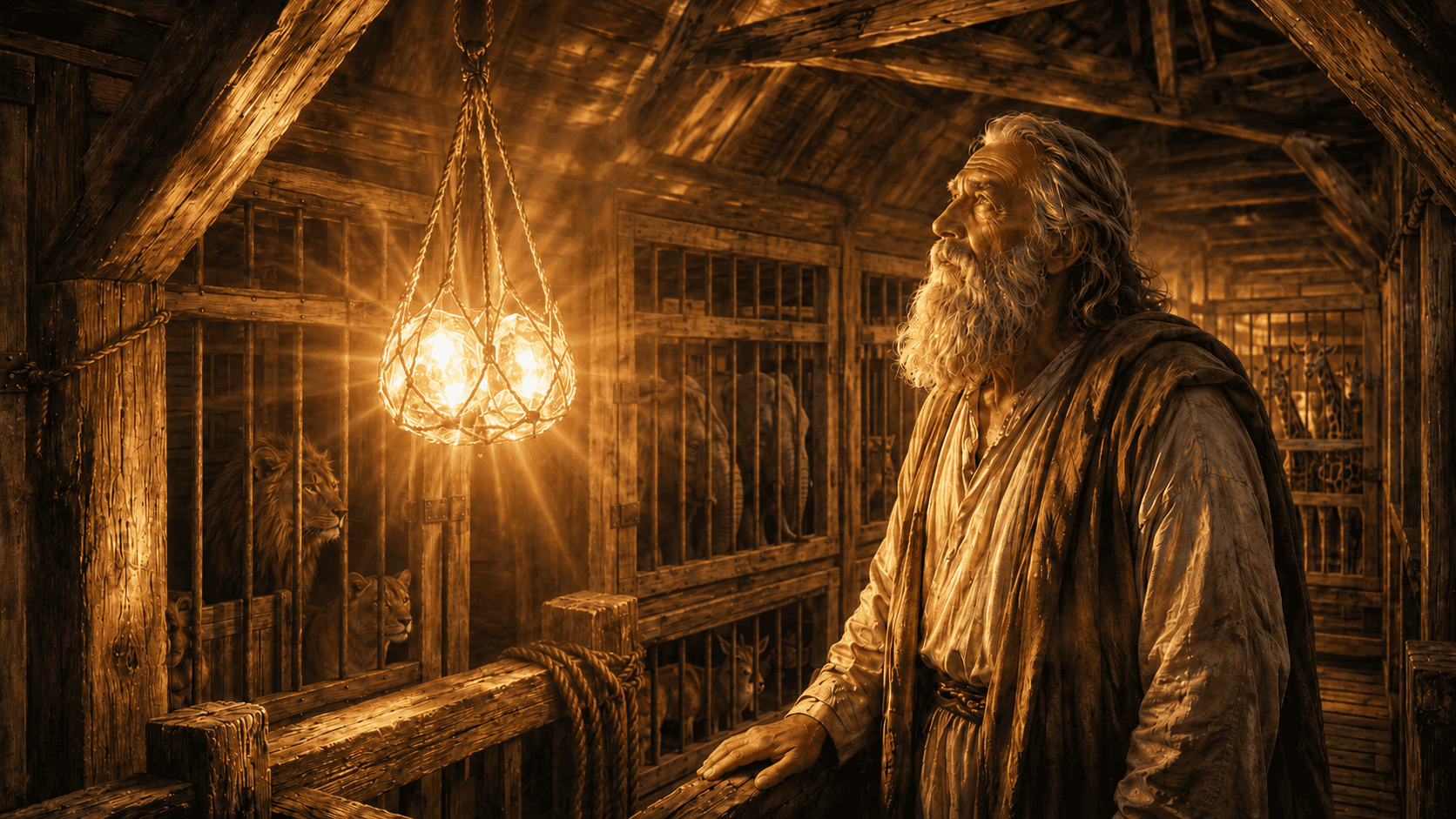
These details are fascinating because rabbinic traditions likewise mention that Noah’s ark was lit by shining stones!11 The Babylonian Talmud reports that the Lord instructed Noah to “set therein precious stones and jewels, so that they may give thee light, bright as the noon.”12 Midrash Rabbah states that “During the whole twelve months that Noah was in the Ark he did not require the light of the sun by day or the light of the moon by night, but he had a polished gem which he hung up.”13
The important point here is that, at least according to some traditions, the ark itself was filled with a supernatural light. This, in turn, provides a new possible interpretation of Moses 7:43. Its statement that the Lord “smiled” upon the ark could mean that he literally filled it with his divine light, similar to the manner in which he illuminated the Jaredite barges.
Conclusion
The phrasing in Moses 7:43 may be significant on multiple fronts. The first thing to consider is that forms of the word “smile” are not found anywhere in the King James Bible. Nevertheless, some modern translations of the high priestly blessing in Numbers 6:25 use “smile” as an appropriate idiom to describe the favorable light of the Lord’s face or countenance, just as seen in 3 Nephi 19. Although we can’t be certain that this light-transferring connotation is intended in Moses 7:43, that conclusion seems likely when one considers that three of the four other usages of “smile” in Joseph Smith’s revelations employ the term in this manner.14
The case is further strengthened when one considers that extrabiblical sources indeed associate Noah’s ark with God’s glorious presence or Shekinah, and also that Noah apparently saw the Lord’s face in connection to entering the ark. Traditions about the ark being filled with divine light facilitated by precious gems or stones are especially intriguing, since a similar motif arises in a similar context in one of Joseph Smith’s other revelations.
Based on sources reasonably available to Smith in 1830, he would have had little reason to believe that Noah’s ark was filled with divine glory.15 Nor does it seem likely that he knew the term “smile” would appropriately communicate the transference of divine light upon an object or person.16 Thus, in addition to illuminating the meaning of Moses 7:43, these subtle connections provide support for the authenticity of the Book of Moses.
Jeffrey M. Bradshaw, Enoch and the Gathering of Zion (Interpreter Foundation, with Scripture Central and Eborn Books, 2021), 132.
John A. Tvedtnes, “Glowing Stones in Ancient and Medieval Lore,” Journal of Book of Mormon Studies 6, no. 2 (1997): 99–123.
Hugh Nibley, Lehi in the Desert/The World of the Jaredites/There Were Jaredites, The Collected Works of Hugh Nibley, Volume 5 (Deseret Book and FARMS, 1988), 358–379.
Bible
Genesis 7:1
Genesis 7:17
Numbers 6:25–26
Psalm 11:7
Psalm 57:5
Book of Mormon
3 Nephi 19:25, 30
Doctrine and Covenants
D&C 84:101
Book of Moses
Moses 7:43
- 1. See also 3 Nephi 19:30: “and he did smile upon them again; and behold they were white, even as Jesus.” Another relevant passage, in which the term “smile” is connected with the imbuing of God’s glory, can be seen in D&C 84:101: “The earth hath travailed and brought forth her strength; And truth is established in her bowels; And the heavens have smiled upon her; And she is clothed with the glory of her God; For he stands in the midst of his people.”
- 2. See Scripture Central, “Book of Mormon Evidence: Christ’s Priestly Blessing,” Evidence 24 (September 19, 2020). See also Scripture Central, “Book of Mormon Evidence: Multiple Priestly Blessings,” Evidence 505 (July 30, 2025).
- 3. The New American Bible (World Bible Publishers, 1976), 143. Likewise, the New Living Translation renders Numbers 6:25 as “May the LORD smile on you and be gracious to you.” The God’s Word translation similarly states, “The LORD will smile on you and be kind to you.”
- 4. Jeffrey M. Bradshaw, Enoch and the Gathering of Zion (Interpreter Foundation, with Scripture Central and Eborn Books, 2021), 132; bolds added.
- 5. To better align with the phrasing of the following commentary, this passage utilizes the English Standard Version of the Old Testament.
- 6. H. Freedman, trans., Midrash Rabbah, ed. H. Freedman and Maurice Simon (Soncino Press, 1939, reprinted 1951 and 1961), 250, online at archive.org.
- 7. See Jeffrey M. Bradshaw, “The Ark and the Tent: Temple Symbolism in the Story of Noah,” Interpreter: A Journal of Latter-day Saint Faith and Scholarship 44 (2021): 93–135.
- 8. Zohar, Noach 27:204–206, online at sefaria.org. A similar notion arises very clearly and prominently in 3 Enoch, in connection to the heavenly ascent of Enoch-Metatron. See Philip Alexander, “3 (Hebrew Apocalypse of) Enoch,” in The Old Testament Pseudepigrapha, 2 vols., ed. James Charlesworth (Doubleday, 1983–1985), 1:241: “God’s transcendence is expressed through the story in 3 Enoch 5:10–14 of the withdrawal of his Šekinah from the earth. The Šekinah is the divine presence which takes up its abode in a place or with a person or group of people. Where God is experienced as present, there his Šekinah is said to dwell. 3 Enoch pictures the Šekinah in very concrete terms: It is a bright light, a luminous cloud, like the cloud that manifested God’s presence in the Temple and the Tabernacle (1Kgs 8:10; Lev 16:2; cf. NumR 12:4; SongR 3:8).”
- 9. Zohar, Noach 27:207, online at sefaria.org.
- 10. Sefer HaYashar, Book of Genesis, online at sefaria.org.
- 11. See Scripture Central, “Book of Mormon Evidence: Shining Stones,” Evidence 12 (September 19, 2020). These traditions may in some way relate to the enigmatic description of the “window” in the KJV of Genesis 6:16: “A window [tzohar] shalt thou make to the ark, and in a cubit shalt thou finish it above.” Because this term “only appears in the Bible once,” writes Howard Schwartz, “it has proven very difficult to define. This is quickly apparent if one examines a variety of biblical translations. Tzohar is sometimes translated as a light, sometimes as a window, sometimes as a dome. … Clearly, it was intended to refer to some source of light.” Howard Schwartz, Reimagining the Bible: The Storytelling of the Rabbis (Oxford University Press, 1998), 17.
- 12. Babylonian Talmud: Tractate Sanhedrin 108b, trans. H. Freedman, ed. Isidore Epstein (Soncino Press, 1935, reprinted 1952, 1956, and 1961), online at come-and-hear.com.
- 13. Midrash Rabbah, trans. H. Freedman, ed. H. Freedman and Maurice Simon (Soncino Press, 1939, reprinted 1951 and 1961), 244, online at archive.org. This glowing stone is referred to as the “tzohar” in Jewish mysticism and is present in the stories of Noah and Abraham. See Rashi on Genesis 6:16, B. Sanhedrin 108b, B. Bava Batra 16b, Zohar 1:11a–11b. See also Howard Schwartz, Tree of Souls: The Mythology of Judaism (Oxford University Press, 2004), 85–88; 332, for traditions on this glowing stone.
- 14. The instances of “smile” being associated with a transference of divine glory can be seen in 3 Nephi 19:25, 30; D&C 84:101. This connotation, if it is present in Jacob 2:8, is not clearly indicated by the surrounding context.
- 15. For a discussion of the limitations of accessing the Zohar and other kabbalistic sources in Joseph Smith’s environment, see Allen Hansen, “Joseph Smith and the Kabbalah: A New Look at the Evidence,” 2024 FAIR Conference, online at fairlatterdaysaints.org. Similar limitations would seem to apply to sources like the Babylonian Talmud and Midrash Rabbah, which weren’t fully available in English until years after Joseph Smith produced the Book of Moses. The same is true for Sefer HaYashar (also known as the book of Jasher), which was first published in English in 1840. See Edward J. Brandt, “The Book of Jasher and the Latter-day Saints,” in Apocryphal Writings and the Latter-day Saints, ed. C. Wilfred Griggs (BYU Religious Studies Center, 1986), 297–318.
- 16. Joseph Smith didn’t formally study Hebrew until 1835. See Matthew J. Grey, “‘The Word of the Lord in the Original’: Joseph Smith’s Study of Hebrew in Kirtland,” in Approaching Antiquity: Joseph Smith and the Ancient World, edited by Lincoln H. Blumell, Matthew J. Grey, and Andrew H. Hedges (BYU Religious Studies Center and Deseret Book, 2015), 249–302.