Evidence #530 | January 28, 2026
Book of Moses Evidence: Role of the Premortal Savior
Post contributed by
Scripture Central
Abstract
Ancient Jewish and Christian sources provide evidence for restored teachings about the council in heaven, as taught in the Book of Moses and other Restoration texts.The Premortal Savior in Restoration Texts
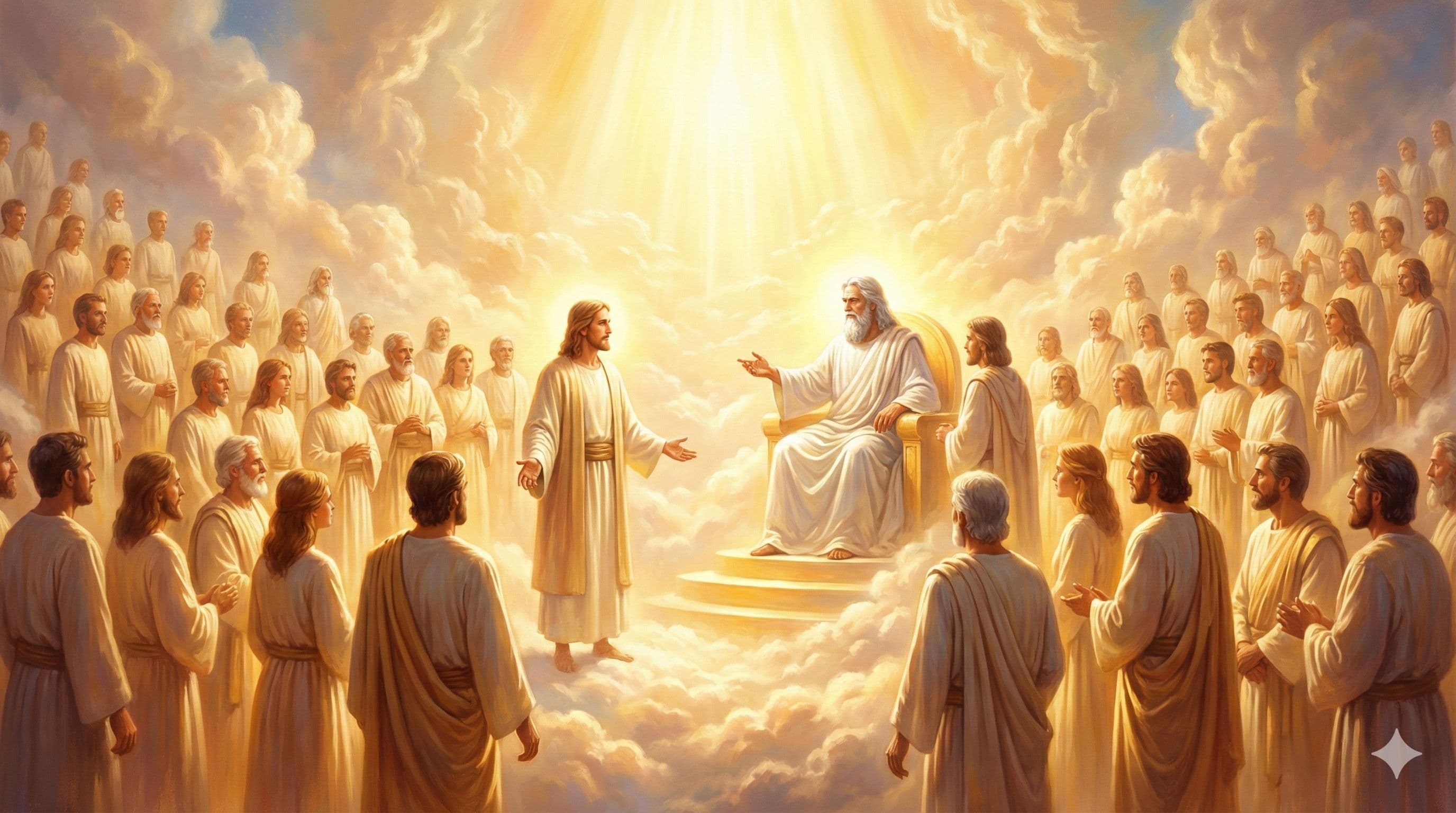
The Lord revealed to Moses that it is God’s work and his glory “to bring to pass the immortality and eternal life of man” (Moses 1:39). Latter-day revelation also teaches that our spirits dwelt with God before receiving mortal bodies, even before the creation of the earth. We were created “spiritually”—that is, as spirits—before our mortal bodies were created (Moses 3:5). We also learn that God gathered all his spirit children in a premortal heavenly council where he revealed his plan of salvation and where a Savior was chosen to become our Redeemer. All those who accepted our Heavenly Father’s plan chose to enter mortality where we would have the opportunity to learn, keep his commandments, and become more like Him.
The Lord revealed to Moses how Jesus offered and was chosen to be our Redeemer. “But, behold, my Beloved Son, which was my Beloved and Chosen from the beginning, said unto me—Father, thy will be done, and the glory be thine forever” (Moses 4:2). Jesus was chosen to do Heavenly Father’s will and show us the way (Moses 4:1–4). The Lord also showed the prophet Abraham how our spirits or intelligences “were organized before the world was” (Abraham 3:22).
And there stood one among them that was like unto God, and he said unto those that were with him: we will go down, for there is space there, and we will take of these materials, and we will make an earth whereon these may dwell; And we will prove them herewith, to see if they will do all these whatsoever the Lord their God shall command them; And they who keep their first estate shall be added upon; and they who keep not their first estate shall not have glory in the same kingdom with those who keep their first estate; and they who keep their second estate shall have glory added upon their heads for ever and ever (Abraham 3:24–26).
Abraham saw that in this heavenly assembly, Jesus volunteered to go down to earth as the Redeemer saying, “Here am I, send me” (Abraham 3:27). At that time, Satan rebelled against God and became the enemy of man (Moses 4:1–6; Abraham 3:28).1
The Premortal Savior in Ancient Traditions
An important ancient Jewish text called 1 Enoch describes a pre-mortal individual known as the “Son of Man” who is chosen by God, the Lord of the Spirits.
At that hour, that Son of man was given a name, in the presence of the Lord of the Spirits, the Before-Time, even before the creation of the sun and the moon, before the creation of the stars, he was given a name in the presence of the Lord of the Spirits. He will become a staff for the righteous ones in order that they may lean on him and not fall. He is the light of the gentiles and he will become the hope of those who are sick in their hearts. All those who dwell upon the earth shall fall and worship before him; they shall glorify, bless, and sing the name of the Lord of the Spirits. For this purpose he became the Chosen One; he was concealed in the presence of (the Lord of the Spirits) prior to the creation of the world, and for eternity …. They will be saved in his name and it is his good pleasure that they have life.2
The individual described in the text has attributes which correlate with the Latter-day Saint understanding of Jesus Christ and his role as one chosen by God before the creation of the sun, moon, and stars (Abraham 4:14–17). The reference to the “Son of Man” also reminds us of the one spoken of in the Book of Abraham who was “like unto the Son of Man” who volunteers to be sent and is chosen by God before the creation of the world (Abraham 3:27).
Early Christian texts unknown in Joseph Smith’s lifetime show traces of an understanding of a pre-mortal council where Jesus and the Father discuss the need for a Savior to redeem mankind. The Discourse on Abbaton, an Egyptian Christian pseudepigraphon attributed to Timothy, Bishop of Alexandria in the fourth century AD, was first translated into English from Coptic in 1914. It recounts the story of the creation, the rebellion of Satan, his being cast down, the fall of man and the future redemption through Jesus Christ. In this account, the Father commands an angel to gather clay from the ground to form a body for man. The earth objects, complaining that mankind will commit all manner of wickedness.3 In spite of the earth’s objections, the angel obeys and brings the clay to God. After man’s body is formed, it lays on the earth for forty days. The Father and the Son then discuss the problem of man’s inevitable transgression and wickedness. The Father states:
“If I put breath into this [man], he must suffer many pains.” And I said unto my Father, “Put breath into him; I will be an advocate for him.” And my Father said unto me, “If I put my breath into him, My Beloved Son, thou wilt be obliged to go down into the world, and to suffer many pains for him, before thou shalt have redeemed and made him come back to his primal state.” And I said unto my Father, “Put breath into him; I will be his advocate and I will go down into the world and I will fulfil thy command.”4
Traces of an understanding of Jesus’ selection to be a Redeemer of mankind can also be found in the teachings of other early Christian texts. While these groups held some teachings that Latter-day Saints would consider to be incorrect—which may be seen as evidence of the predicted apostasy—these groups also held beliefs which may reflect authentic early Christian teachings. The third century Christian writer Hyppolytus, Bishop of Portus, described the teachings of one gnostic group called the Nassenes. He recounted a psalm sung by adherents which portrays Jesus speaking to the Father on behalf of the soul of man subjected to chaos and misery, and death.
Father, behold:
Pursued by evils here upon the earth
There roams the (work) of thine own breath.
It seeks to escape the bitter chaos
But knows not how it shall win through.
Therefore, send me, Father.
Bearing the seals I will descend.
I will pass through all the Aeons.
I will disclose the mysteries.
I will show the forms of the Gods
And Hidden things of the holy way.
Awaking knowledge (gnosis), I will impart.5
Another early Christian document, the Second Treatise of the Great Seth, is a gnostic Christian text discovered in Egypt in 1948. The text was written sometime before 400 AD and reflects the teachings of a group of Egyptian Christians previous to that time. It again contains a mixture of Christian teachings as well as other doctrines which Latter-day Saints would consider to be erroneous, such as the idea that Jesus did not really suffer on the cross. On the other hand, the text draws upon other valid Christian ideas from the New Testament, such as the concept of a heavenly Church (Ephesians 3:14–15; Hebrews 2:9–12). The text, according to Joseph A. Gibbons who first translated it into English, portrays an event which “took place among the heavenly church before the foundation of the world.”6 The document, he further states:
begins in the spiritual world, the realm of the Supreme God and the Mother. The speaker, to be identified later with Jesus Christ, asserts that he originates from this celestial region and that he is the revealer (i.e., he brings forth the “word”). The speaker calls together the heavenly church and presents his plan: he is to come forth to reveal “the glory” (i.e. gnosis) to those on earth who are kin to the celestial beings. The heavenly church then gives its approval to the plan.7
Jesus, the speaker in the text, states:
Let us gather an assembly together. Let us visit that creation of his. Let us send someone forth into it, just as he visited <the> Ennoias, the regions below. And I said these things to the whole multitude of the multitudinous assembly of the rejoicing majesty. The whole house of the Father of Truth rejoiced that I am the one who is from them …. And they all had a single mind since it is out of one. They charged me since I was willing. I came forth to reveal the glory to my kindred and my fellow spirits …. I did not refuse them even to become a Christ.8
Conclusion
Ancient sources and early Christian traditions describe the pre-mortal selection of Jesus as the Redeemer. They also report on his willingness to do the will of Heavenly Father by coming down to earth to be our Savior. This evidence, found primarily in ancient texts discovered subsequent to the Restoration of the Books of Moses and Abraham, points to the plausible antiquity of Joseph Smith’s revelations on this subject.
Dana M. Pike, “Formed in and Called from the Womb,” in To Seek the Law of the Lord: Essays in Honor of John W. Welch, ed. Paul Y. Hoskisson and Daniel C. Peterson (Interpreter Foundation, 2017), 317–331.
Matthew Roper, “Book of Job on Premortal Existence of ‘First Man,’” Insights: An Ancient Window 33, no. 1 (2013): 5–6.
Bible
Job 38:4
Job 38:7
Jeremiah 1:4–5
1 Peter 1:19–20
Doctrine and Covenants
D&C 38:1
D&C 49:17
D&C 93:29
D&C 121:32
D&C 124:33–34
D&C 130:2-21
D&C 132:5
D&C 132:11
D&C 138:56
Pearl of Great Price
Moses 3:5
Moses 4:1-4
Abraham 1:3
Abraham 3:22–28
Abraham 3:22–28
- 1. See Scripture Central, “Book of Moses Evidence: Satan’s Origin Story,” Evidence 493 (May 7, 2025).
- 2. 1 Enoch 48:2–8. Translation by E. Isaac, “1 (Ethiopic Apocalypse of) Enoch,” in The Old Testament Pseudepigrapha, 2 vols., ed. James H. Charlesworth (Garden City, NY: Doubleday & Company, 1983), 1:35. See also S. Kent Brown and Jeffrey M. Bradshaw, “Man and Son of Man: Probing Theology and Christology in the Book of Moses and in Jewish and Christian Tradition,” in Tracing Ancient Threads in the Book of Moses: Inspired Origins, Temple Contexts, and Literary Qualities, Volume 2, ed. Jeffrey M. Bradshaw, David Rolph Seely, John W. Welch, and Scott A. Gordon (The Interpreter Foundation and Eborn Books, 2021), 1257–1332.
- 3. This compares well with the mourning and groaning of the earth in Moses 7:48–49, 56. See Scripture Central, “Book of Moses Evidence: Themes of Weeping,” Evidence 525 (December 23, 2025).
- 4. E. A. Wallis Budge, Coptic Martyrdoms Etc. in the Dialect of Upper Egypt, (London: Oxford University Press, 1914), 482.
- 5. Werner Foerster, Gnosis: A Selection of Gnostic Texts, 2 vols., ed. and trans. R. McL. Wilson (Oxford: Clarendon Press, 1972), 1:282; emphasis added.
- 6. Joseph A. Gibbons, “The Second Logos of the Great Seth: Considerations and Questions,” Society of Biblical Literature Seminar Papers 2 (1973): 245.
- 7. Gibbons, “The Second Logos of the Great Seth,” 243. See also, Scripture Central, “Book of Moses Evidence: Adam’s Premortal Existence,” Evidence 523 (December 10, 2025).
- 8. James M. Robinson, The Nag Hammadi Library in English, Third, Completely Revised edition (Harper & Row, 1988), 363. Traces of a similar idea can be found in later Zoroastrian teachings. A text which dates to the 13th century describes Ohrmazd (God) counseling with the preincarnate souls (fravahrs) of mankind about their willingness to become mortal where they will have to contend with evil, represented by Ahriman: “‘Which seemeth more profitable to you, whether that I should fashion you forth in material form and that you should strive incarnate with the Lie and destroy it, and that we should resurrect you at the end, whole and immortal, and recreate you in material form, and that you should eternally be immortal, unaging, and without enemies; or that you should eternally be preserved from the aggressor?’ And the Fravahrs of men saw by that omniscient wisdom that they would suffer evil from the Lie and Ahriman in the world, but because at the end...they would be resurrected free from the enmity of the Adversary, whole and immortal forever and ever, they agreed to go into the material world.” Bundahisn, 3:23–24, in R. C. Zaehner, The Teachings of the Magi: A Compendium of Zoroastrian Beliefs (New York: Oxford University Press, 1976), 41.